This past June I had the opportunity to revisit two of the sites of my Fulbright research done in Italy in 2006. With a travel grant from the Brooklyn Heights Montessori School, where I work as an administrator, I was able to see the Gigli Festa in Nola and spend time with friends in Salemi, Sicily. It was also interesting to see the changes I had read about and what had remained the same. Part 1 is my report on my travels to Nola, where I ate fabulous Southern Italian cuisine of Campania and again marveled at the paper mache folk art.
 |
| "Emotion" Giglio |
Late afternoon, in the still
brilliant sunshine and intense Southern Italian heat, a small group of Americans
were cooling off poolside, eating home-made fig cookies which we dipped in tumblers
of local wine. We had come to Nola, Italy, for the Festa of the Gigli, celebrated
for more than 1500 years, likely making it Italy’s oldest saint’s feast. Almost every southern Italian town and
village honors its special saint with a festival and in Nola the feast day of
its patron, San Paolino, is celebrated with raucous music, exquisite folk art
and amazing demonstrations of physical strength.
Everyone in Nola, including my new Italian-Americans
friends, Ersilia Iorio Graziano and Anthony Casalino, loves to tell the story
of what San Paolino did for the town. “Very simply, he won freedom for his
people,” Anthony told me. The legend goes that in 409 AD, Nola was sacked by
the Goths and many of its men were carried off to North Africa as slaves.
Bishop Paolino ransacked his church, selling anything of value to ransom the
enslaved Nolani men. When a widow implored him to get back her only son,
Paolino offered himself in exchange.
After three years in
captivity, Paolino won freedom for himself and the village men. The grateful
women of Nola, each waving bouquets of lilies (gigli,) met their returning
boat.
Ersilia, a petite, attractive woman
in her mid-60’s, was born in Nola but moved with her family to the Bronx when
she was a child. “My family has been involved with the feast going way back –
my father, my grandfather, my uncles,” she said. “I used to come for the feast
when I was a teenager and then as an adult. I brought my son Marc when he was
six years old and this year I had to show the feast to my fourteen-year-old
grandson, Daniel, and again to Marc.”
 |
| Boat in Piazza Duomo |
I told Ersilia and Anthony that I discovered
the Giglio Festa seven years ago when I heard a CD of the festival songs for
the celebration in Williamsburg, Brooklyn, where the great-grandchildren of
Nola immigrants continue the feast traditions. I remember staring at the
picture of a seven-story tower, decorated with paper-mache images of angels,
saints and flowers. The base was a platform holding a twelve-piece brass band
and singer performing Neapolitan songs. This four-ton structure was carried on the shoulders of 120 men. It was
preposterous and fantastic and I wanted to know more about it, so I went to Nola
in 2006 as a Fulbright Scholar, to study the giglio, and to Sicily to study the
St. Joseph feast, also celebrated in Italian-American communities in the U.S.
I’m not Italian but my Puerto Rican
and French Canadian families also celebrate holidays and family events in ways
dictated by traditions and customs passed down through generations. I’m really
drawn to the community spirit, the drama and the special foods of the saints’
feasts. My interest began with the
giglio song, “O Giglio e Paradiso” and eventually encompassed a fascination
with the folk art of both feasts.
 |
| Hotel Bel Sito |
 |
| Inviting Hotel Pool |
This is the tenth year Anthony has
come to Nola to participate in the giglio celebration. He explained, “My family
has been involved in the giglio for hundreds of years, in Italy and then in
Brooklyn after they emigrated to the U.S. in the 1890’s. So it’s easy to understand my love for
this feast; it’s part of my DNA.” Anthony’s massive shoulders and muscular arms
fairly scream “lifter” and he does lift the giglio in both Nola and Brooklyn.
A half hour drive from Naples, Nola
lies on the other side of Vesuvius to the northeast, in the plain between the volcano
and the Apennine Mountains. I arrived June 20, four days before the day San
Paolino is honored with a procession of eight 85-foot wooden towers plus a
large boat (symbol of the boat that brought Paolino and Nola’s men home), carried
on the shoulders of teams of men. I arrived lunch time at the Hotel Bel Sito, a
lushly landscaped oasis, located on the outskirts of Nola on strip mall-like Via
San Paolino Belsito. The pool was incredibly inviting in the torrid heat but I was
anxious to get into town to see the gigli. First I dined at the hotel – a
no-brainer and a delicious one at that: pasta con frutti di mare (fat pasta
rings in a light tomato sauce with tiny clams and plump mussels), grilled tuna
bathed in olive oil and a mixed salad with shaved fennel. The prix fixe menu (lunch or dinner)
was €20 (about $25.)
Now I was ready to see the boat and
the eight giglio towers, scattered throughout town in various piazzas where
they had been erected. These spires, taller than most of Nola’s buildings, are
giant representations of the bouquets of lilies first offered in gratitude to San
Paolino. Walking through Nola, I met an old friend, Antonio Napolitano,
director of La Contea Nolana, a volunteer cultural society concerned with all
things giglio.
 |
| Paper Mache piece at Bottega Tudisco |
He took me to see the three
bottegas (workshops) that produce the paper-mache facades for all the giglio
towers. I struggled to keep up with his pace and stride, as he explained the
evolution of the gigli and boat from the simple bouquets left at the cathedral
after Paolino’s death to today’s ornate constructions. He told me that first
the bouquets were mounted on poles; eventually a base was created to support
the poles and then the top was crowned with a statue of S. Paolino. Nola’s
citizens proceeded through the town carrying candles, torches and the
now-mounted gigli. I asked Antonio why eight gigli. He told me, “A crazy
competition began during the Middle Ages and carried on into the Renaissance
when eight trade and artisan guilds vied to create taller and more magnificent
gigli. So now, eight gigli for the eight trades and guilds.”
Eventually the height was set at
eighty-five feet and when the brass bands and festive music were added in the
seventeenth century, the gigli began to dance as they were carried through the
streets. The emotion-filled singing, a vocal style combining bel canto operatic
tradition and street vendor cries, and the booming music resounding from
different directions through the narrow streets, adds a cacophonous note to the
spectacle. Antonio thinks music contributes a feminine element. He told me, “When
the giglio dances, it moves like a woman and we all dance with it.”
At the Bottega d’arte Tudisco, family-run
for nearly three hundred years, Antonio introduced me to its director, Gaetano
Tudisco, who happily showed me the plaster molds in which paper and glue are
layered to make the paper-mache elements - angels, saints, baroque arabesques,
etc. – used to create the magnificent facades. The workshop was strewn with pieces
of unpainted paper-mache and Gaetano said of course, I could take some; rejects
to him but prized souvenirs for me.
 |
| Giglio di Pane |
I mentioned to Gaetano I had also
studied a feast that used bread as a decorative element and he excitedly told
Antonio, “Take her to see my giglio for panettiere (the baker’s guild).”
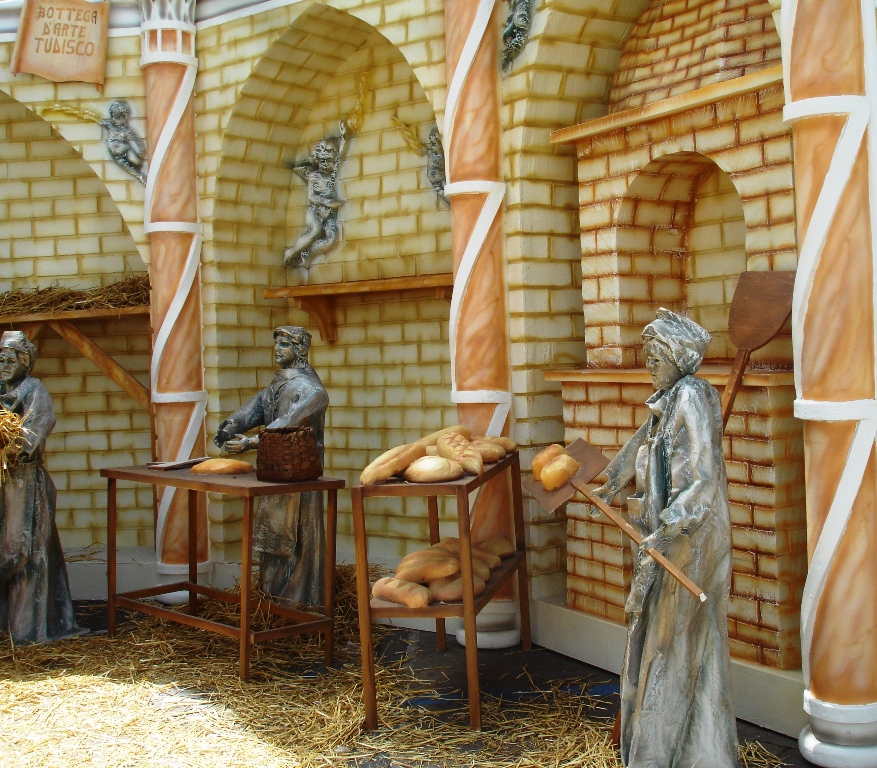
Charming and delightful, this giglio was surrounded by a paper-mache village,
starring the bread maker pulling loaves from his oven.
 |
| Paper Mache bakers |
The celebration began just before
noon. Sound equipment was put in place and the singers and the twelve-piece
bands mounted the platforms of each giglio. The men put their shoulders under
poles inserted in the platforms and at the command of their leader, raised the
massive towers off the grounds for the all-important “aizata” or first lift.
Per tradition, baba au rhum and coffee provided by the giglio’s sponsor were
served to people gathered at each giglio. The first lift is a dramatic moment.
Ersilia told me “Daniel was absolutely amazed. I can tell you my Nola cousins
wept.”
One by one each of the eight gigli
and the boat were carried into Piazza Duomo - so full of people that the boat
seemed to navigate a sea of heads and waving arms as it made its way to sit in
front of the Municipal Building. The eight gigli were lined up, facing each
other, four each flanking two sides of the Piazza. After they received a
blessing from the Bishop, the paranza went off to eat and then rest before the start
that evening of the gigli’s all-night dance. Ersilia told me that when she was
a girl, “the paranza’s always ate sandwiches filled with beef braciola and drank
red wine sipped through fennel stalks, like straws. For strength. It was always
served in people’s homes but now the paranza go to restaurants.” (Of course, I
got Ersilia’s braciola recipe.)
 |
| Tattoo Arms |
Men are the protagonists of this
feast and pass on the traditions, father to son. They build the towers and
prove their strength and stamina by carrying the huge gigli. Working in
concert, supporting each other’s efforts, the strain evident on their faces,
the lifters endure pain and fatigue in their body-punishing labor. Wives,
mothers and girlfriends support their awesome performance, by following with
towels to mop their sweat and water to quench their thirst. As I photographed a
giglio carried by a team of lifters called “Fantastic Team,” a beautiful young
woman, wearing a dress better described as lingerie, handed me a big pink button
boldly inscribed: “Fantastic Team Girl” and declared, “Sono fantastico, si?” I thought about my conversation the day
before, at a café with Dr. Katia Bellanchino, an anthropology professor at the
University of Rome. Katia, who earned her doctorate studying the Giglio, had confided,
“I really love these guys. I love the beautiful tattoos of San Paolino and the
giglio blazoned on their powerful arms and legs.” With all its religious
aspects, the feast atmosphere is also charged with lots of testosterone and sexuality. Think Mastroianni and Loren.
 |
| San Paolino Tattoo |
Antonio, fiftyish, and not
especially muscular, lifts when given the chance. He said, “I can’t describe the emotion I feel when I lift
the giglio. It’s a way to elevate our souls.” Nicola Vecchione proudly showed me the calloused bump on his shoulder, his badge of honor as a cullatore (lifter) and explained that term to me. "Cullatore means to rock a baby and we both lift and rock the giglio.) Anthony Casalino lifts to pay
homage to his immigrant grandparents. “The heavy weight of the giglio and the
soreness to my shoulder pales in comparison to their hardships. It’s my small
token of gratitude.”
The beautiful wooden giants, rising
above the roof-tops, proceeded along the narrow, winding streets teeming with
Nolani and visitors following the gigli.
From their balconies, people showered the towers with confetti, flower
petals. By early morning the gigli and boat were back at Piazza Duomo where
they remained on view for two days, until the “abbatimento,” the knock down and
destruction of the gigli and boat. There’s no place to store the towers so,
sadly, they are destroyed and built anew each year.
 |
| Knock Down |
Although the giglio festivities are
pretty all-consuming, there are other attractions in the Nola/Naples area. The
Circumvesuviano railroad circles Mt Vesuvius to connect Naples, Nola, Pompeii, Ercolano
(the ancient Herculaneum) and access to a hiking trail up the ever-present volcano.
There are a few less expensive B & B's in Nola center but the Hotel Bel Sito’s pool,
wifi and air-conditioning make it an attractive choice (doubles are around €100, including breakfast.) Nola offers many restaurants specializing in seafood
and classic Neapolitan pizza. O’Cellario, a pizzeria/trattoria near Piazza Calabrese serves
Marguerita pizza, classic or, my favorite: crudo style with slices of sweet San
Marzano tomatoes, mozzarella di bufalo and fresh basil on a crust brushed with
fruity olive oil (€5.) The succulent, huge grilled prawns at La Cicerenella on
Via Tansillo were a knockout for €12.
Dining in its garden, under the canopy created by banana palms, olive and
citrus trees, I knew if I could, I would return every year to experience the
giddy, sublime joy of following the crazy dance of the gigli.