Showing posts with label Art and Culture event. Show all posts

Monday, January 21, 2013

A Tale of Two Feasts - Part 1


This past June I had the opportunity to revisit two of the sites of my Fulbright research done in Italy in 2006. With a travel grant from the Brooklyn Heights Montessori School, where I work as an administrator, I was able to see the Gigli Festa in Nola and spend time with friends in Salemi, Sicily. It was also interesting to see the changes I had read about and what had remained the same. Part 1 is my report on my travels to Nola, where I ate fabulous Southern Italian cuisine of Campania and again marveled at the paper mache folk art.  


"Emotion" Giglio
 Late afternoon, in the still brilliant sunshine and intense Southern Italian heat, a small group of Americans were cooling off poolside, eating home-made fig cookies which we dipped in tumblers of local wine. We had come to Nola, Italy, for the Festa of the Gigli, celebrated for more than 1500 years, likely making it Italy’s oldest saint’s feast.  Almost every southern Italian town and village honors its special saint with a festival and in Nola the feast day of its patron, San Paolino, is celebrated with raucous music, exquisite folk art and amazing demonstrations of physical strength.

Everyone in Nola, including my new Italian-Americans friends, Ersilia Iorio Graziano and Anthony Casalino, loves to tell the story of what San Paolino did for the town. “Very simply, he won freedom for his people,” Anthony told me. The legend goes that in 409 AD, Nola was sacked by the Goths and many of its men were carried off to North Africa as slaves. Bishop Paolino ransacked his church, selling anything of value to ransom the enslaved Nolani men. When a widow implored him to get back her only son, Paolino offered himself in exchange.  After three years  in captivity, Paolino won freedom for himself and the village men. The grateful women of Nola, each waving bouquets of lilies (gigli,) met their returning boat.

Ersilia, a petite, attractive woman in her mid-60’s, was born in Nola but moved with her family to the Bronx when she was a child. “My family has been involved with the feast going way back – my father, my grandfather, my uncles,” she said. “I used to come for the feast when I was a teenager and then as an adult. I brought my son Marc when he was six years old and this year I had to show the feast to my fourteen-year-old grandson, Daniel, and again to Marc.”


Boat in Piazza Duomo
I told Ersilia and Anthony that I discovered the Giglio Festa seven years ago when I heard a CD of the festival songs for the celebration in Williamsburg, Brooklyn, where the great-grandchildren of Nola immigrants continue the feast traditions. I remember staring at the picture of a seven-story tower, decorated with paper-mache images of angels, saints and flowers. The base was a platform holding a twelve-piece brass band and singer performing Neapolitan songs. This four-ton   structure was carried on the shoulders of 120 men. It was preposterous and fantastic and I wanted to know more about it, so I went to Nola in 2006 as a Fulbright Scholar, to study the giglio, and to Sicily to study the St. Joseph feast, also celebrated in Italian-American communities in the U.S.

I’m not Italian but my Puerto Rican and French Canadian families also celebrate holidays and family events in ways dictated by traditions and customs passed down through generations. I’m really drawn to the community spirit, the drama and the special foods of the saints’ feasts.  My interest began with the giglio song, “O Giglio e Paradiso” and eventually encompassed a fascination with the folk art of both feasts.


Hotel Bel Sito
Inviting Hotel Pool


This is the tenth year Anthony has come to Nola to participate in the giglio celebration. He explained, “My family has been involved in the giglio for hundreds of years, in Italy and then in Brooklyn after they emigrated to the U.S. in the 1890’s.  So it’s easy to understand my love for this feast; it’s part of my DNA.” Anthony’s massive shoulders and muscular arms fairly scream “lifter” and he does lift the giglio in both Nola and Brooklyn.

A half hour drive from Naples, Nola lies on the other side of Vesuvius to the northeast, in the plain between the volcano and the Apennine Mountains. I arrived June 20, four days before the day San Paolino is honored with a procession of eight 85-foot wooden towers plus a large boat (symbol of the boat that brought Paolino and Nola’s men home), carried on the shoulders of teams of men. I arrived lunch time at the Hotel Bel Sito, a lushly landscaped oasis, located on the outskirts of Nola on strip mall-like Via San Paolino Belsito. The pool was incredibly inviting in the torrid heat but I was anxious to get into town to see the gigli. First I dined at the hotel – a no-brainer and a delicious one at that: pasta con frutti di mare (fat pasta rings in a light tomato sauce with tiny clams and plump mussels), grilled tuna bathed in olive oil and a mixed salad with shaved fennel.  The prix fixe menu (lunch or dinner) was 20 (about $25.)

Now I was ready to see the boat and the eight giglio towers, scattered throughout town in various piazzas where they had been erected. These spires, taller than most of Nola’s buildings, are giant representations of the bouquets of lilies first offered in gratitude to San Paolino. Walking through Nola, I met an old friend, Antonio Napolitano, director of La Contea Nolana, a volunteer cultural society concerned with all things giglio.  


Paper Mache piece at Bottega Tudisco
         He took me to see the three bottegas (workshops) that produce the paper-mache facades for all the giglio towers. I struggled to keep up with his pace and stride, as he explained the evolution of the gigli and boat from the simple bouquets left at the cathedral after Paolino’s death to today’s ornate constructions. He told me that first the bouquets were mounted on poles; eventually a base was created to support the poles and then the top was crowned with a statue of S. Paolino. Nola’s citizens proceeded through the town carrying candles, torches and the now-mounted gigli. I asked Antonio why eight gigli. He told me, “A crazy competition began during the Middle Ages and carried on into the Renaissance when eight trade and artisan guilds vied to create taller and more magnificent gigli. So now, eight gigli for the eight trades and guilds.”

          Eventually the height was set at eighty-five feet and when the brass bands and festive music were added in the seventeenth century, the gigli began to dance as they were carried through the streets. The emotion-filled singing, a vocal style combining bel canto operatic tradition and street vendor cries, and the booming music resounding from different directions through the narrow streets, adds a cacophonous note to the spectacle. Antonio thinks music contributes a feminine element. He told me, “When the giglio dances, it moves like a woman and we all dance with it.”

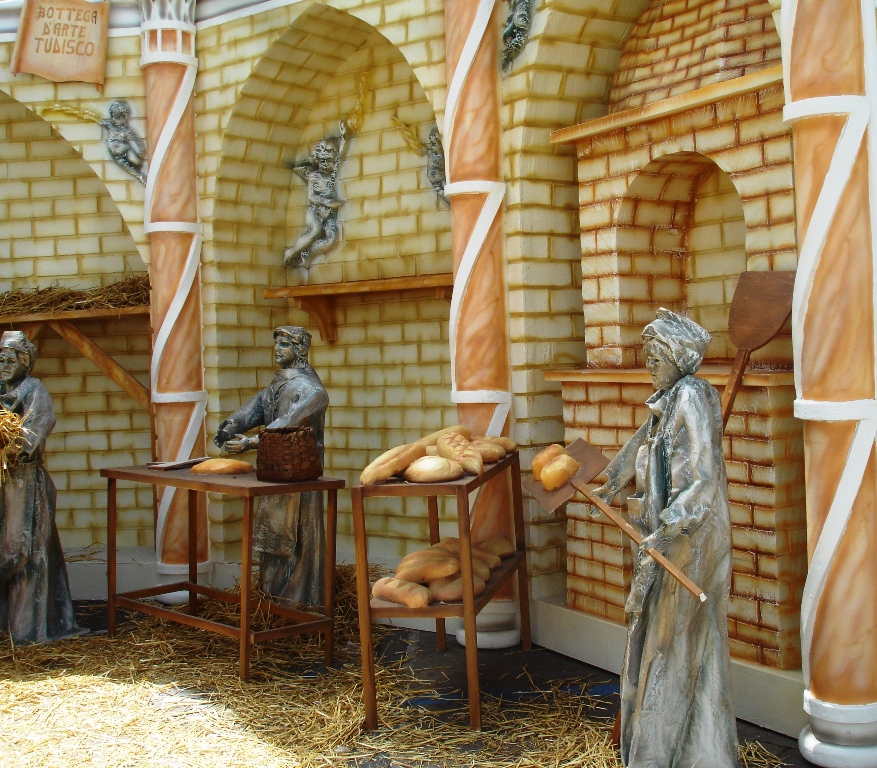
At the Bottega d’arte Tudisco, family-run for nearly three hundred years, Antonio introduced me to its director, Gaetano Tudisco, who happily showed me the plaster molds in which paper and glue are layered to make the paper-mache elements - angels, saints, baroque arabesques, etc. – used to create the magnificent facades. The workshop was strewn with pieces of unpainted paper-mache and Gaetano said of course, I could take some; rejects to him but prized souvenirs for me.


Giglio di Pane
I mentioned to Gaetano I had also studied a feast that used bread as a decorative element and he excitedly told Antonio, “Take her to see my giglio for panettiere (the baker’s guild).” Charming and delightful, this giglio was surrounded by a paper-mache village, starring the bread maker pulling loaves from his oven.

Paper Mache bakers
           The celebration began just before noon. Sound equipment was put in place and the singers and the twelve-piece bands mounted the platforms of each giglio. The men put their shoulders under poles inserted in the platforms and at the command of their leader, raised the massive towers off the grounds for the all-important “aizata” or first lift. Per tradition, baba au rhum and coffee provided by the giglio’s sponsor were served to people gathered at each giglio. The first lift is a dramatic moment. Ersilia told me “Daniel was absolutely amazed. I can tell you my Nola cousins wept.”
One by one each of the eight gigli and the boat were carried into Piazza Duomo - so full of people that the boat seemed to navigate a sea of heads and waving arms as it made its way to sit in front of the Municipal Building. The eight gigli were lined up, facing each other, four each flanking two sides of the Piazza. After they received a blessing from the Bishop, the paranza went off to eat and then rest before the start that evening of the gigli’s all-night dance. Ersilia told me that when she was a girl, “the paranza’s always ate sandwiches filled with beef braciola and drank red wine sipped through fennel stalks, like straws. For strength. It was always served in people’s homes but now the paranza go to restaurants.” (Of course, I got Ersilia’s braciola recipe.)

Tattoo Arms
Men are the protagonists of this feast and pass on the traditions, father to son. They build the towers and prove their strength and stamina by carrying the huge gigli. Working in concert, supporting each other’s efforts, the strain evident on their faces, the lifters endure pain and fatigue in their body-punishing labor. Wives, mothers and girlfriends support their awesome performance, by following with towels to mop their sweat and water to quench their thirst. As I photographed a giglio carried by a team of lifters called “Fantastic Team,” a beautiful young woman, wearing a dress better described as lingerie, handed me a big pink button boldly inscribed: “Fantastic Team Girl” and declared, “Sono fantastico, si?”  I thought about my conversation the day before, at a cafĂ© with Dr. Katia Bellanchino, an anthropology professor at the University of Rome. Katia, who earned her doctorate studying the Giglio, had confided, “I really love these guys. I love the beautiful tattoos of San Paolino and the giglio blazoned on their powerful arms and legs.” With all its religious aspects, the feast atmosphere is also charged with lots of testosterone and sexuality. Think Mastroianni and Loren.
San Paolino Tattoo

Antonio, fiftyish, and not especially muscular, lifts when given the chance. He said, “I can’t describe the emotion I feel when I lift the giglio. It’s a way to elevate our souls.” Nicola Vecchione proudly showed me the calloused bump on his shoulder, his badge of honor as a cullatore (lifter) and explained that term to me. "Cullatore means to rock a baby and we both lift and rock the giglio.) Anthony Casalino lifts to pay homage to his immigrant grandparents. “The heavy weight of the giglio and the soreness to my shoulder pales in comparison to their hardships. It’s my small token of gratitude.”

The beautiful wooden giants, rising above the roof-tops, proceeded along the narrow, winding streets teeming with Nolani and visitors following the gigli.  From their balconies, people showered the towers with confetti, flower petals. By early morning the gigli and boat were back at Piazza Duomo where they remained on view for two days, until the “abbatimento,” the knock down and destruction of the gigli and boat. There’s no place to store the towers so, sadly, they are destroyed and built anew each year.

Knock Down
Although the giglio festivities are pretty all-consuming, there are other attractions in the Nola/Naples area. The Circumvesuviano railroad circles Mt Vesuvius to connect Naples, Nola, Pompeii, Ercolano (the ancient Herculaneum) and access to a hiking trail up the ever-present volcano.

            There are a few less expensive B & B's in Nola center but the Hotel Bel Sito’s pool, wifi and air-conditioning make it an attractive choice (doubles are around 100, including breakfast.) Nola offers many restaurants specializing in seafood and classic Neapolitan pizza.  O’Cellario, a pizzeria/trattoria near Piazza Calabrese serves Marguerita pizza, classic or, my favorite: crudo style with slices of sweet San Marzano tomatoes, mozzarella di bufalo and fresh basil on a crust brushed with fruity olive oil (€5.) The succulent, huge grilled prawns at La Cicerenella on Via Tansillo were a knockout for 12. Dining in its garden, under the canopy created by banana palms, olive and citrus trees, I knew if I could, I would return every year to experience the giddy, sublime joy of following the crazy dance of the gigli.  

Monday, January 9, 2012

Festa, Family & Food


Before I started Stevie's Artisans Urban Fok Art, I curated for and managed the gift shop at the Bronx Museum of the Arts. And before that, I spent 9 months in Italy as a Fulbright Scholar researching a project about folk art, cultural traditions, music and food.

Of course, I have tons of photos and lots to say about my project so I have begun doing presentations. My project, Festa, Family and Food, is a study of continuity, change and identity manifested in three saints' feasts celebrated both in Italy and in Italian-American communities in the US. The key themes of all three feasts are sacrifice and redemption, suffering, survival and communal rejoicing and celebration. The feasts honor three heroic and charasmatic figures (saints) who rescued their communities from destruction and ruin.


Women and their daughters make bread, crafted in myriad shapes and forms, as the principle element used to decorate the altars and banquet tables created to celebrate the feast of St.Joseph in Sicily and New Orleans. Papier-mache is the art form used to create ornately sculpted facades for the 85-foot towers - the giglio - carried on the shoulders of men through the streets of Nola and Williamsburg, Brooklyn. The towers dance to music, all in honor of St Paulinus, who in the fifth century, rescued Nola's men from slavery at the hands of the Saracens. The Ceri is a race through the streets of Gubbio and Jessup, Pennsylvania of three Baroque wooden towers born on the shoulders of a nine-man team, to honor St Ubaldo who saved his town in the eleventh century from sack and ruin by the Vandals.


This past November 17, I gave a presentation - commentary and power point photo presentation at the Italian American Museum in New York's Little Italy. I'm going to be presenting at the Brooklyn Historical Society on March 29, 2012. That presentation will focus on the giglio celebration in Brooklyn with background information of the celebration in Nola, Italy. Danny Vecchiano, leader of the Vecchiano Festival Band and archivist of American tradtional giglio music will join me. I wrote an article about Danny - Born to Giglio - for "Voices" the New York Folklore Society magazine. I am hoping Danny - a superb trumpeter - plays giglio music for us.


Born to Giglio,
a celebration of a Brooklyn Neighborhood, will be Thursday, March 29, 2012 at 7:00 PM at the Brooklyn Historical Society on Pierrepont Street in Brooklyn Heights.

Monday, March 7, 2011

Berlin

In February I spent a fabulous week in Berlin. My friend Sharon Avery Fahlstrom curated an exhibition of her husband, Oyvind Fahlstrom's work at the Aurel Scheibler Gallery in the Mitte section of the former East Berlin. I arrived two days before the opening so I was able to help out a bit - I helped Aurel's assistant Rebecca attach wall labels while Sharon made the rounds of the gallery, dabbing touch-ups on the walls. One of my favorites - "The Garden" is in this show.

The show is beautiful and has generated glowing reviews in the Berlin & the Frankfurt press. The show comes down the end of April except for The Garden. That piece will be up until the third week of June. After the opening we all celebrated at a lovely dinner hosted by Aurel at a nearby restaurant, Sale e Tabachi. The menu was orechiette con broccoli rabe, grilled bronzino with a fennel/caper sauce and lemon sorbet in vodka for dessert. And of course, copious amounts of wine. (Sharon and I shared several memorable meals at Sale & Tabachi: calves' liver in a Marsala reduction & fried sage leaves, and for a late dinner - vitello tonato for me and a lovely seafood soup for Sharon.)

It was bitter cold but luckily my hotel was so well located I could walk down the Unter den Li
nden a couple of blocks to the Brandenburg Gate and then to Peter Eisenman's Holocaust Memorial - a sculptural land art piece that reminded me a little of the Cretto di Burri - Alberto Burri's memorial to the 1968 earthquake victims of Gibellina, Sicily. The next day I went to Daniel Libeskind's Jewish Museum - an architectural masterpiece. BTW, my son Michael Scaduto graduated from the Cooper Union School of Architecture. Eisenman was one of his teachers, Libeskind is a Cooper Union alumna and I also saw a house deigned by John Hejduk - former Dean of CU School of Architecture. Cooper Union is well represented in Berlin.

When the Berlin Wall came down in 1989, a friend brought me a small zip-l
ock bag filled with pieces of "wall" rubble. On the sidewalk outside the hotel I stayed at is a standing segment of the wall, beautifully graffiti decorated. Many of the streets are clearly marked with a cobblestone line, to mark where the wall separated East from West. Checkpoint Charlie still stands as a Cold War Era monument and you can have your photo taken with an actor portraying a U.S. or Soviet soldier - just like the "gladiators" posing outside the Colosseum in Rome. There is also the "Wall" museum - very much a home-made collection of cold war/wall memorabilia, art and personal mementos donated by Berliners. It's all slightly cheesy but absolutely heartfelt.

Towards the end of my trip I met with one
of the Stevies Artisans, Naemeh Shirazi who now lives and creates her sculpted lace jewelry in Berlin. We met at a hip coffee house - St Oberholtz in Rosenthaler Platz. (It is so easy to get around Berlin on public transport: the UBahn subway and the elevated SBahn and buses & trams.) Naemeh and I caught up over dinner - foccacia, pork schnitzel and creamy broccoli soup for Naemeh - and we exchanged 20 yards of lace and 2 bottles of dye I brought from NYC so she can make lots of beautiful lace earrings, many in new styles she has developed. She gave me a ton of new inventory which I've added to my website, which is now live - http://www.steviesartisans.com

On our last day Berlin we hit the art museums. Our whirlwind visit began with the Neues National - a Mies Van der Rohe
building that houses a superb modern art collection: Kirchner, Dix, Klee, Picasso, etc. Then we headed for Museum island for the Pergamon to see the cobalt blue tiled Ishtar Gate, the colossal Market Gate of Miletus and the Pergamon Altar which is even more magnificent then the Elgin Marbles at the British Museum. We had a Turkish meal at the Pergamon Museum cafe - a splendid idea to serve a menu that is themed to the art collection. Then we went on to the Neues Museum to see the bust of Nefertiti and a lovely Egyptian art and sculpture collection.

We ended th
e day with a very quick tour of the Hamburger Bahnhoff led by the director, Udo Kittlemann (a friend of Sharon). The Hamburg Bahnhof, a former railway terminus is repurposed as the national contemporary art museum: Joseph Beuy's archive and art, Cy Twombly, Roy Lichtenstein, Warhol, etc.

Built in 1848, the Hamburger Bahnhof is the only surviving terminus in Berlin from the late neoclassical period and is one of the oldest station buildings in all of Germany. I loved the vaulted central gallery with its steel trusses - I know Sharon could imagine Falhlstrom's works installed in that space. Udo led us through an endless series of huge open galleries - spaces designed for really big works. Dusk was edging into night when we left and the building glowed with a Dan Flavin light installation. Magical!

I'd like to report that we ended our last day in Berlin with a fabulous meal, but instead we had an acceptable meal at Berlin's so called "best" restaurant. We should have gone back to Sale e Tabachi. I left the next morning - bitter cold but filled with brilliant sunshine - perfect for my bus ride to the airport to return home. I look forward to returning some spring to see the linden trees in full bloom on the Unter den Linden.


Sunday, April 18, 2010

Hot Saturday


Hot Saturday at Linger Cafe and Lounge presents fashions by Ivette Urbaez
(photos of dresses by Ivette above and details of Hot Saturday below.)

Stevie's Artisans Blog has been MIA for a couple of months. So to catch up - I left the retail store I had been selling from because I'm not sure it was the right showcase for most of the artisans. Then again the economy hasn't been so conducive to lots of buying activity. So, I have been concentrating on building an ecommerce web site which is slowly coming to fruitition. It should be up soon, very soon - I hope.

And, once the web site storefront is up I will have a retail outlet for the artisans I have been working with: Ivette Urbaez, Lis Ortiz, Naemeh Shirazi, Diana Pucci, Aaron Lazansky, et al.
In the meantime...

I recently began working with an incredible Haitian designer who creates very classy and well constructed dresses from recycled umbrellas. Catherine Charlot deconstructs her umbrellas and then constructs the "pieces" into beautifully fashioned cocktail dresses that are fully lined and have intricate overstitching worked into the design. Catherine also works with lots of young designers instructing them in business concepts, promotion and marketing as well as seamstress skills.

This dynamic lady and I have teamed up to promote and introduce the work of emerging artists and designers in fun get-together/networking events that include music and good food. We are calling the events Hot Saturday and we are working with a smart and talented lady, Jessica Pichardo, to produce these events at her cafe: Linger Cafe & Lounge on Atlantic Avenue in Brooklyn. The plan is to schedule the events on a monthly basis. In some cases we'll schedule a trunk sale for the Friday after the Saturday event.

Hot Saturday at Linger Cafe & Lounge kicks off Saturday, April 24 from 7-10 pm with a fashion show presentation of Dominican artist and designer Ivette Urbaez's silk screened fashions. Ivette brands her apparel with her distinctive themes and motifs: Bold Roses, Thorns & Roses and Fire Escapes - edgy, urban and Hot!

The Linger Cafe & Lounge menu will offer Empanadas, Ropa Vieja & Moros y Cristianos (rice and black beans) More taste of Latin culture is provided by the wine and beer selections, including Sangria and the Dominican Republic's own Presidente beer. The "Flavor" continues with Salsa, Merengue and other Caribbean beats. Dancing encouraged.

A raffle will be held to benefit the Collective Hands Foundation: aid to arts education. Donated raffle items include an Ivette Urbaez tote bag, a Kate Designs embroidered bag and a fashion item by Catherine Charlot.

Upcoming Hot Saturday events:

May: Multi-cultural eats and wearable art by Stevie's Artisans: Ortiz, Pucci, Ahn and Shirazi
June: Kompa, good food & upcycling your look with Haitian designer Catherine Charlot and work by father/daughter artists Arturo and Ellen Carranza
July: Hip Hop Culture: Street Art, Break Dancing, Stand-up and Spoken Word

Details in future blogs and eblasts.

See you next Saturday at Linger Cafe & Lounge, 533 Atlantic Avenue, (bet 3rd & 4th Ave.)
steviesartisans@gmail.com
enfo@chfoundation.org