Showing posts with label Sicily. Show all posts

Thursday, July 24, 2014

Festa, Family and Food Presentations

This is the proposal I send out to Italian-American cultural groups to interest them in my presentations. I gave a presentation to an Italian Language club in May at Our Lady of Grace Church in Gravesend, Brooklyn. I'm returning to their group in September to talk about another passion: Regional Italian Cuisine.

FESTA, FAMILY AND FOOD
 The Origins & Traditions of Three Italian Festivals 
A Fulbright Project
by
Stephanie Trudeau


About the Presentation:
This presentation is an examination of the evolution and continuity of the cultural traditions of three saints’ feasts, the Gigli in Nola, the Ceri in Gubbio and St. Joseph’s feast in Salemi, Sicily. These festivals unite their communities in creative, cooperative effort toward a common goal and the feasts’ artwork, music and celebratory foods illustrate and symbolize their historical tales of heroic sacrifice and redemption. The enduring strength of these feasts may be because they reinforce the pride and identity of the citizens of communities so impoverished in the past that it gave impetus to the Italian diaspora of the late 19th century. The feasts celebrate suffering, rejoicing and survival, and their folk art serves to reshape historical narratives and social identities in a modern society. This nine-month research project examined the evolution of these feasts from pagan rites to Christian celebrations, their artwork combining contemporary design with the baroque, all serving as expressions of cultural identity.

The photographs and commentary bring to life the elements of the feasts’ preparations and celebrations:
·        Women and their daughters make bread, crafted in myriad shapes and forms, as the principal element used to decorate the altars and banquet tables created for St. Joseph’s feast.
·        Papier-mâché is the art form used to create ornately sculpted facades for the 85-foot towers - the gigli - carried on the shoulders of men through the streets of Nola to celebrate the Festa dei Gigli. 
·        The Ceri is a race through the streets of Gubbio of three huge wooden cylinders, each crowned with a statue of a saint and also borne on the shoulders of a nine-man team. Men and their sons carry on the traditions of both the Gigli and the Ceri.

The duration of the presentation is about 45 minutes with a half-hour Q&A period.

About the Presenter:
Stephanie Trudeau is a singer/actress/writer who worked nine years as a music educator at several Catholic elementary schools in Brooklyn. After completing her B.S. in 2005 on the History and Performance of American Popular Song, she began a research project on the continuity of Italian culture and traditions in Italian-American communities. In 2006 she was awarded a Fulbright Scholarship to Italy to continue her Festa research, in which she compared and contrasted the traditions of the feasts as they are celebrated in both Italy and the U.S. After completing her Fulbright she began working at The Bronx Museum of the Arts as manager of the museum book/gift shop. After leaving the Bronx Museum Stephanie created a company, Stevie’s Artisans Urban Folk Art, which sells the work of four artisans. She has presented her Festa photos at DeVry College in New Jersey, The Brooklyn Historical Society and The Italian American Historical Society of Providence, RI. Her article, Born to Giglio, published in 2005 in “Voices, The Journal of New York Folklore,” was the start of this Festa journey.

The following introduction was used by the Italian American Museum for a recent speaking engagement:  The Italian American Museum invites you to a photo presentation of a Fulbright project entitled, "Festa, Family and Food." Please join us as Fulbright scholar Stephanie Trudeau presents a lecture with power point presentation on the history and cultural significance of three saints’ festivals celebrated in Italy and in Italian-American communities.

Wednesday, January 23, 2013

A Tale of Two Feasts - Part 2

          After celebrating the Festa dei Gigli, at the end of June, I flew to Salemi, Sicily, a medieval hill town of steep and narrow cobble-stoned streets, located an hour’s drive south of Palermo’s airport.  I had come to see old friends and revisit St. Joseph’s feast, celebrated throughout Sicily but most quintessentially in Salemi. 


Salemi Street
Salemi with Castle in Background


The giglio feast is about sacrifice and homecoming and St Joseph's feast is about sustenance and survival. It honors Sicily’s patron who, according to legend, ended a severe drought that devastated the island during the Middle Ages. Sicilians prayed to St. Joseph and after the rain finally came and the drought and hunger ended, Sicilian villages prepared banquets to thank their saint, who is also patron of the home, family, carpenters and pastry chefs – truly a multi-tasking saint. Sicilian immigrants brought the feast traditions to New Orleans, when they settled there in the 1870’s. St Joseph altars are still created and banquets are served in many churches, community centers and private homes throughout New Orleans.

At the top of this hill town of 12,000 people, at one end of Piazza Alicia, sits an imposing 12th century Norman castle. At the opposite end are the ruins of the “Mother Church” destroyed by an earthquake in 1615 and now used as an open-air theater. Gaetano Scomegna, community liaison, walked with me through the areas ruined by the 1969 earthquake and pointed out what had been the thriving Jewish ghetto when Salemi was an Arab outpost. “These were the houses the mayor wanted to sell for one euro as a way to get people to rebuild the ancient town center,” he said.  It was the idea of Vittorio Sgarbi, a former cultural minister and former mayor of Salemi. Many houses have been renovated and those houses had sweeping views of the valley below and the rugged hills beyond.


Altar Festooned with Laurel and Breads

(Unbaked) Roses & Grapes
Fava Beans
Nadie Vultaggio

          Women organize and make this feast. They prepare the foods and create the signature folk art of this feast - bread, crafted in myriad designs, shapes and forms, that decorate the altar and banquet table. Six years ago, when I spent a month working with several Salemi women, learning to make the simpler ritual breads, I asked master bread-makers Anna Catalanotta and Nadie Vultaggio who had taught them to make the incredible designs. Anna answered, "You learn from your mother or by doing it with other women." Nadie nodded in agreement. Now I was back at family dinner at Nadie's house, reminiscing  as we looked at photos from this year’s celebration.

Anna Catalanotta


Three Tiered Altar with Jesus, Mary & St. Joseph Breads
A wonderful cook, Nadie served breaded pork cutlets, potatoes mashed with cheese and then baked, salad from Nadie’s garden and home-baked bread. I told her as delicious as the meal was, I was sorry it wasn't pasta with sardines (pasta con le sarde) a dish she and Ann had taught me to make. She reminded me that meal had taken all of a Saturday morning to prepare. But what a lovely family lunch that had been.

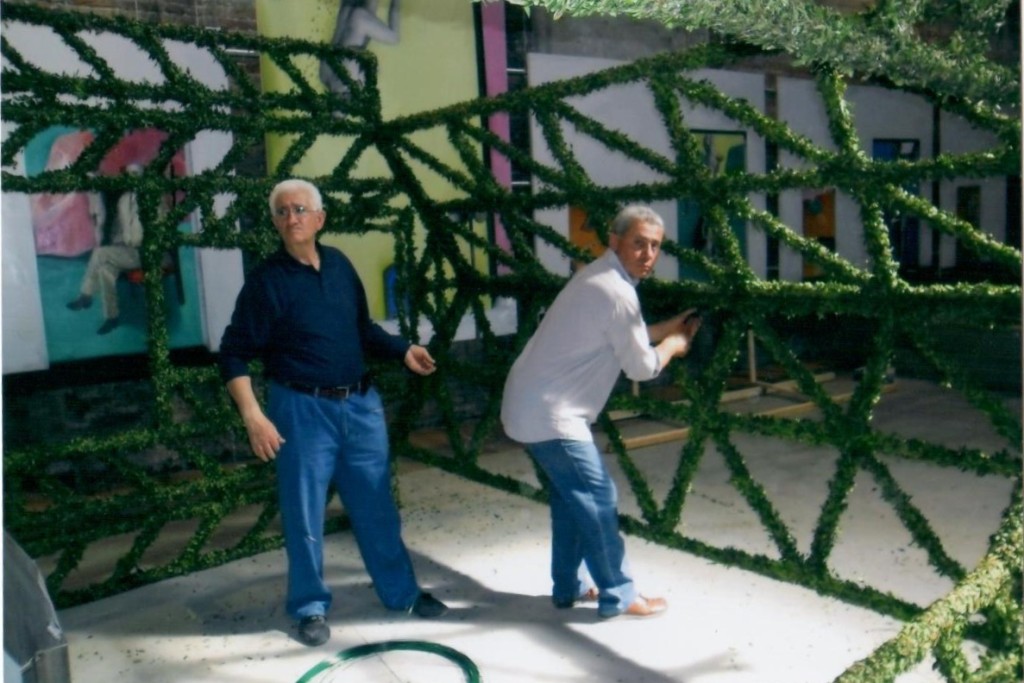
 Looking at photos of the town-sponsored altar, I remembered how I was first stunned by the artful creation made by Anna, Nadie and the other women.The St. Joseph banquets of the Middle Ages were simple affairs; tables set up in the town squares, laden with food provided by the landed gentry to feed the peasantry. Today’s celebration has evolved into an elaborate mise en scene. In Salemi tall arches (errected by men) festooned with laurel leaves, citrus fruits and decorative breads in the shapes of spring fruits, vegetables, birds and animals framed the altar (three-tiered to represent the Trinity) overflowing with flowers, prepared foods, wine and pastries - representations of fertility and abundance.

Orange & Breads on Laurel Covered Altar Frame
 On each tier were three large breads, each decorated with iconography (made of bread) of the members of the Holy Family. St Joseph's bread was decorated with carpentry tools, Jesus' bread with the cross, crown of thorns and other symbols of the Passion and on Mary's bread were seamstress' tools and roses. Interspersed were bowls of breadcrumbs to represent the sawdust of St. Joseph the carpenter.


St. Joseph's Bread


Jesus' Bread

            Three children portraying Jesus, Mary and Joseph, were served a multi-course meal, each course announced with a drum roll. No meat is served because St. Joseph's feast falls mid-Lent, a time of fasting and meatless meals for observant Christians. After the three children were served, dishes were passed to the clamoring townspeople - a reenactment of hunger. The children's meal ended as all good Italian meals do, with cafe. In this case, I beleive the children were served mostly milk touched with coffee. Finally, everyone was served a traditional meal of spaghetti, olive oil and cinnamon, sprinkled with toasted breadcrumbs. Although some breads are saved as souvenirs, most are eaten and new breads and new altars are recreated each year. Like the gigli this feast’s folk art is also ephemeral.

            Although I spent a month, six years ago, watching and helping the women make the hundreds of breads needed to decorate the altar, I never became adept at it. But then, they spend their lives learning to make these breads. Mostly I cut circles that they fashioned into roses and I rolled little balls of dough that became clusters of grapes. When I downplayed my contribution to the final effort, Anna pulled me to the altar and pointing out every rose and grape cluster, said, "Stefania, those are all yours."
Anna's Hands
Anna & Nadie's husbands applying the Laurel to the Altar Frame

Now there is a Bread Museum with an altar, banquet table and vitrines displaying examples of the breads and descriptions of their significance to the feast. There is also a display altar at the new Hotel Villa Mokarta, located just outside town on the road to the Villa Mokarta archeological dig – site of a Bronze Age village dating to 1250 B.C. The hotel has spacious rooms, wifi, a pool and a superb restaurant where I ate the best meal of my trip: spaghetti with sautéed zucchini and shrimp, a salad of local tomatoes, grilled swordfish seasoned with thyme, ripe melon drizzled with balsamic vinegar and a glass of a very good Nero d’Avola (€25 or around $33.)

Doric Temple at Segesta
Within a half hour’s drive are lovely beaches, a Greek theater and temples to rival any in Greece. To the south is Selinunte, where five temples in varying degrees of ruin sit on a high plain overlooking the crystalline sea. In spring one walks through fields of fragrant wildflowers to reach them and in summer you can cool off at the golden beaches below. North of Salemi, Segesta’s massive Doric temple is sited on a hill in the midst of rolling green countryside. Hike up or take the tram to the top of nearby Monte Barbaro to reach the Greek theater, now a venue for plays, concerts and other events. Its back-drop opens onto a sweeping vista of the vineyards and rolling hills of the western Sicilian countryside. 

Sicily and Campania, the region of Naples and Nola, are still quite agrarian and as my Salemi friend Gaetano reminded me, “The feasts aren’t celebrated like this in the big cities. Here they are remnants of a time when it was easier and necessary for people to work together.” Standing on the stage of that 2000-year-old theatre, I reflected on my path from the raucous festivities of the giglio feast honoring sacrifice and a very good deed done for a widow to a grand Sicilian feast where I  was allowed to play a small roll.